


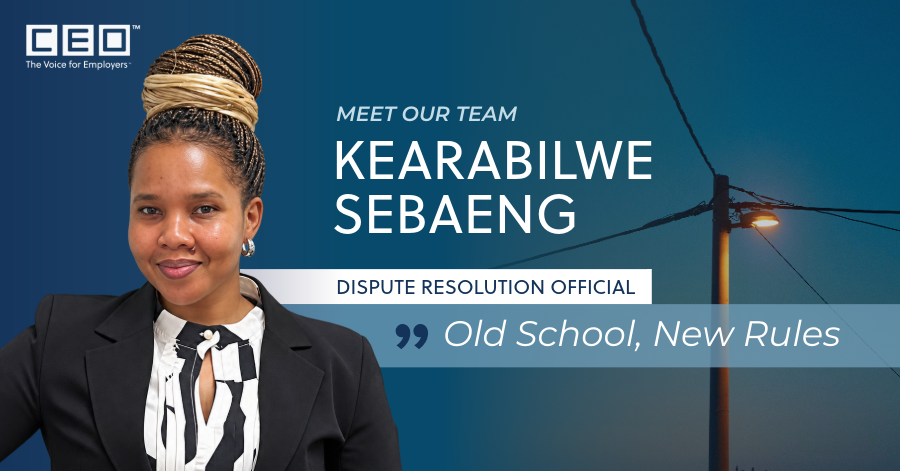
The streets of Rustenburg did not come with a search bar. When Kearabilwe Sebaeng was growing up, boredom was not something you solved by reaching for a smartphone. You went outside, found whoever else was around and invented something to do. There were friends to play with, an older brother and sister to keep things interesting, and long afternoons that required neither a Wi-Fi connection nor a fully charged battery.
It was, as Kearabilwe remembers, a wonderfully low-tech childhood. And while she has embraced the conveniences of modern technology, she still looks back on those simpler days with considerable affection.
There is something rather amusing about that when you discover what Kearabilwe imagines for her future. She would happily have a self-driving car take her to client meetings, particularly on days when she is too tired to drive. She also looks forward to advances in legal technology that will make research more efficient and professional services more accessible.
The little girl who once found all the entertainment she needed in the streets of Rustenburg has become a woman who can scarcely imagine life without her mobile phone.
Yet Kearabilwe is no unquestioning convert to the digital age. She is particularly concerned about the growing tendency of legal professionals to rely on artificial intelligence without properly checking its work. AI can produce convincing answers, but those answers are not necessarily correct. In a profession where an incorrect legal reference or poorly researched argument can have serious consequences, she believes technology must remain a tool rather than a substitute for professional judgement.
It is an interesting position for someone so enthusiastic about the possibilities of technology, but it says a great deal about how she approaches life. Progress is worth embracing, provided we do not discard the qualities that made progress possible in the first place.
Her mother, a laboratory technician, has been one of the strongest examples of that principle. Having overcome numerous professional barriers, she taught Kearabilwe the importance of resilience, perseverance and believing in her own abilities. Her older sister has provided equally important support, particularly during difficult periods when encouragement was needed more than another piece of advice.
Those influences helped Kearabilwe build a career that has taken her considerably further than her first job in retail.
Today, she is an admitted attorney and a Dispute Resolution Official at the Consolidated Employers’ Organisation (CEO), a progression of which she is understandably proud. Her attraction to law comes from a genuine interest in justice and the satisfaction of solving problems. She enjoys getting to grips with a difficult situation, examining the available options and working towards a practical outcome for the people she represents.
Interestingly, it was an old-fashioned personal connection rather than a sophisticated recruitment algorithm that introduced her to CEO.
Her childhood friend, Keotshepile Kodisang, who is now also a colleague, told her about the organisation. The friendship formed long before technology became such a prominent feature of everyday life had opened a new professional opportunity. Sometimes the most useful network is still the one you build with actual people.
At CEO, Kearabilwe has found a working environment that appeals to both sides of her personality. She values its progressive outlook and the opportunities to develop specialist knowledge across industries and bargaining councils. Equally important is the organisation’s approach to collective bargaining, which seeks to protect employers’ interests while recognising the need for industries to remain sustainable over the longer term.
Kearabilwe sees considerable potential for technology to improve that work. Better research tools, more reliable access to information and greater efficiency could give legal professionals more time to concentrate on the matters requiring their expertise. But the qualities she values most remain distinctly human. Sound judgement, empathy, accountability and the ability to understand another person’s position are not things she is prepared to surrender to a machine.
That also reflects the kind of professional she hopes to become. She wants to develop her leadership abilities and inspire others through confidence, integrity and empathy. Friends already describe her as bubbly, dedicated and confident, while motherhood has given her another important perspective on responsibility and setting an example.
Away from work, she still enjoys something resembling those childhood afternoons in Rustenburg. A walk in the park, a hike or a quiet escape from the city gives her the opportunity to disconnect from the demands of everyday life. There is also room for old-school R&B and gospel music, although her phone is unlikely to be very far away.
And if she could revisit one financial decision, she admits she might have invested in Apple shares a little earlier. Given her enthusiasm for technology, it would have been a rather appropriate investment.
For now, Kearabilwe is content to keep learning, developing and looking towards a future in which technology makes life easier without making human connection less important.
Perhaps that is the most useful lesson from her story. The tools we use will continue to change, and the possibilities they create may be difficult to imagine today. But good judgement, perseverance and an understanding of people are unlikely to become obsolete.
And if that self-driving car ever arrives, Kearabilwe will probably be delighted to hand over the steering wheel. Just don’t expect her to hand over the thinking.
Leave A Comment